Web-to-print-lösningar för B2B-styrning


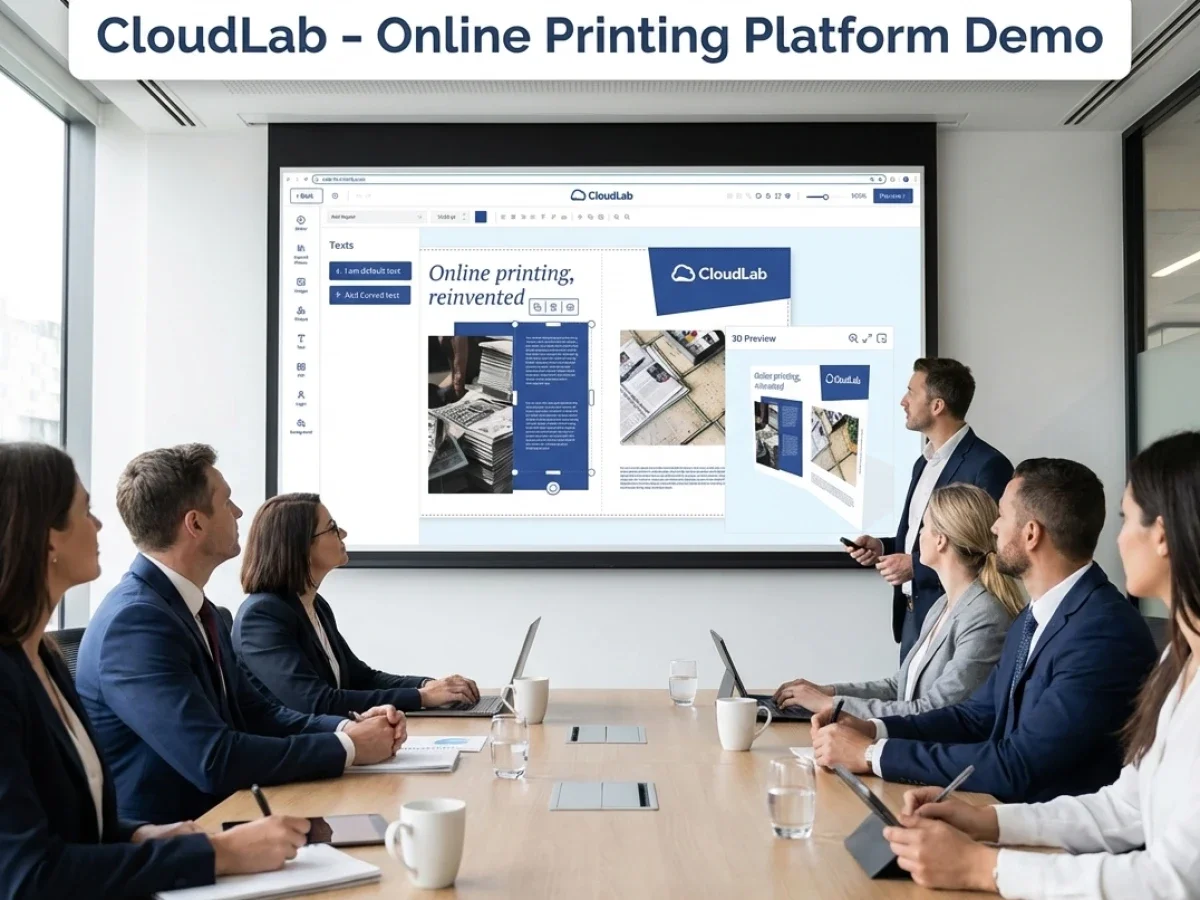
Web to print solutions need governance before they need design freedom
For many companies, web to print solutions are purchased to make ordering faster. That is only half the job. In a B2B portal, speed without control creates new problems just as quickly as it removes old ones. Orders move faster, yes, but so do wrong logos, outdated disclaimers, unapproved prices, budget overruns, and files that are technically not ready for production.
That is why governance matters so much. In real organizations, printed material is rarely touched by just one team. Corporate marketing defines the rules, local teams need room to act, procurement wants cost control, IT wants stable data flows, and production wants clean files. A good B2B portal has to satisfy all of them at once, which is exactly where most basic tools start to crack.
With printQ, the conversation becomes more mature from the start. It is not positioned as a lightweight add-on editor, but as a premium Magento-based web-to-print platform for modern printers, agencies, and enterprises. That framing matters because governance and clearance processes are not side features. They sit at the center of a platform that has to combine commerce, personalization, approvals, automation, and scale.
What governance and clearance mean inside a B2B portal
Governance in a web-to-print environment is the rule system behind the storefront. It decides who can see which products, who can edit which fields, who can place an order, who has to approve it, how budgets are assigned, and how data is passed into connected systems. In practical terms, governance is the difference between a portal that looks professional and a portal that is actually safe to use at scale.
Clearance is the release logic that moves a job from draft to approved order to production-ready output. In B2B portals, clearance can include brand review, legal review, budget approval, department sign-off, proof validation, and technical checks before the file is allowed to flow downstream. When people talk about “approval workflows,” they often mean only one slice of clearance. In reality, clearance is the full chain of controlled release.
That distinction matters for decision-makers. Marketing teams think in terms of corporate design and brand consistency. IT teams think in terms of permissions, integrations, and structured data exchange. Operations teams think in terms of cycle time, repeatability, and fewer manual touchpoints. A platform that supports governance and clearance well gives each group what it needs without creating friction for the others.
Why do governance and clearance processes break as organizations scale?
The first reason is fragmentation. Many companies still manage printed assets with email requests, shared folders, PDFs, local agency files, and manual review loops. That may function for ten users and a few products. It fails the moment the same organization needs to serve fifty branches, three regions, multiple languages, or a franchise network with local offers and central brand rules.
The second reason is that too many systems treat customization as the main event and governance as an afterthought. Users can edit, upload, and order, but the logic around permissions, negotiated catalogs, cost centers, budgets, and role-based approvals is weak or bolted on. That creates shadow processes outside the portal. Once people step outside the portal, the supposed control of the platform disappears.
The third reason is manuality. If proofing, file checks, release, and production handoff still depend on repetitive human intervention, every extra brand, location, or product line multiplies the workload. Governance then becomes unpopular because people associate it with delay. The real problem is not governance itself. It is governance that has not been automated well enough.
Which web to print solutions can manage B2B portal governance end to end?
The strongest platforms do not separate storefront convenience from operational discipline. They connect a usable front end with rules, templates, approvals, pricing logic, and downstream automation. That is the reason printQ fits this topic so well. It supports public B2C shops and protected B2B portals in the same environment, so printers and enterprises do not have to build one system for growth and another for control. In practice, a b2b web to print storefront can sit beside a b2c web to print storefront without separate infrastructure.
A major differentiator is architecture. printQ is the only web-to-print solution built on Adobe Magento, which gives it much deeper e-commerce capabilities than most standalone design tools or proprietary storefronts. Customer accounts, catalog logic, promotions, shipping, payments, negotiated pricing models, and extension options are already part of the foundation rather than custom workarounds. In B2B governance, that foundation matters because rules around who buys what, at which price, under which conditions, are commerce questions as much as design questions.
The operating model is flexible as well. Some organizations want fast deployment, managed infrastructure, and centralized updates, which makes the SaaS option attractive. Others need on-premise deployment because of internal IT policies, procurement requirements, or data-hosting preferences. printQ supports both, which makes it credible as web to print SaaS and as a self-hosted enterprise platform. That flexibility is especially valuable in enterprise B2B settings, where software selection is often constrained by governance long before users even see the editor.
How printQ structures control without slowing local ordering
A B2B portal only works if central control and local usability can coexist. printQ handles that through a combination of open shops and closed shops. Public storefronts are useful when printers want to sell broadly, attract new customers, and run standard online print commerce. Closed shops serve a different purpose. They are protected portals for corporate clients, franchise networks, dealers, branches, or internal departments that need predefined products, role-based access, and controlled ordering paths.
Inside those closed environments, roles do most of the heavy lifting. A headquarters marketing team might define the templates and decide which products are visible. A local branch manager might personalize certain fields and submit an order. A supervisor or budget owner might release the job. Because the role model is built into the portal, the business does not need to recreate the approval structure with emails and side conversations every time someone needs a batch of cards, flyers, signage, or point-of-sale material.
The same logic applies to budgets and cost allocation. In a true B2B portal, an order is not just a design request. It is a governed business transaction. printQ supports the kind of stored commercial logic that enterprise users need, including negotiated catalogs, user-specific permissions, and approval-aware ordering flows. That turns a B2B storefront into an accountable procurement environment instead of a branded self-service toy.
How is printQ different from a basic editor or a generic storefront tool?
A basic editor helps users move text, upload an image, and export a file. A generic storefront tool helps users browse products and check out. Neither one automatically creates a reliable governance model. What printQ does differently is connect the design layer, the approval layer, the commerce layer, and the production layer. Its editor also supports 2D and 3D previews, vectorization, and embellishment visualization, so approvals are based on a much truer picture of the final product. That is the gap many buyers underestimate when they compare solutions only by editor look and feel.
The Adobe Commerce foundation adds a second layer of separation from lighter tools. Commerce depth matters in B2B because ordering rules, customer groups, negotiated prices, shipping methods, and account structures are not secondary details. They shape how compliant ordering happens in the real world. If the commerce side is weak, the governance model becomes hard to maintain.
There is also the question of scale. printQ is built to grow from a single shop to hundreds of multi-client portals managed through one backend. For agencies, that means white-label environments for multiple brands. For printers, it means public storefronts and customer-specific portals under one roof. For enterprise groups, it means one platform can serve multiple business units without duplicating governance logic from scratch.
Template governance starts before the order form
In B2B portals, templates are not just a convenience feature. They are the mechanism that translates brand policy into day-to-day behavior. The printQ Template Gallery is important because it gives users a controlled starting point instead of a blank canvas. That single shift changes the governance model. Users are no longer building assets from zero. They are working inside a predefined design and business framework.
That framework becomes even stronger when one design needs to serve multiple formats. printQ’s dynamic layouts and “one design, many formats” logic help central teams avoid rebuilding the same campaign asset again and again for flyers, posters, cards, catalogs, or signage. For governance, this is more than a time saver. It reduces layout drift, keeps campaigns visually coherent, and lowers the chance that a local team will create an off-brand workaround because the official file only exists in one size.
The InDesign workflow adds another serious advantage. Many organizations already have approved designs built in Adobe InDesign. With printQ, those templates can be prepared and imported into the web-to-print environment instead of recreated from scratch. That protects earlier design investment and shortens time to rollout. It also creates a cleaner bridge between professional design teams and everyday portal users.
One of the most useful parts of that workflow is the three-layer logic. Background elements can be locked, editable elements can sit in the middle layer, and protected foreground elements such as logos or key brand assets can remain fixed on top. This is a practical governance model, not a theoretical one. It lets local users personalize what must change while keeping core brand elements protected from accidental or creative damage.
How do you create approval-ready templates without turning marketing into a bottleneck?
The answer is to control the editable zones, not every individual order. Headquarters should define what is fixed, what is variable, and what must trigger review. A sales office can update a phone number, event date, or regional contact person without asking central marketing to rebuild the design. A local manager can swap a location photo into an approved poster layout without touching the structure of the asset. That is what makes template governance usable, especially when the underlying product configuration and pricing rules are already embedded in the portal.
printQ supports this model with template-based personalization, Variable Data Printing, including PDF/VT-based workflows, and smart forms. Required fields can be validated, incomplete entries can be flagged, and variable data can be fed through CSV or Excel-based uploads into controlled layouts. For large organizations, that is how thousands of assets can be personalized without losing control of brand structure, copy logic, or production consistency.
The browser experience matters, too. If the governed path is slow or awkward, users will avoid it. printQ’s WYSIWYG editor keeps the process visual, direct, and usable for non-designers. It also supports mobile image uploads via QR code, which sounds like a small feature until a field team needs to place a local photo into an approved template without juggling file transfers. Good governance is often won or lost in these small moments of usability.
From draft to release: where clearance becomes operational
Many teams think clearance starts when someone clicks an approval button. In practice, it starts much earlier. Live visual proofing is one part of that. printQ’s 2D and 3D previews help stakeholders understand what they are actually approving before the job reaches production. That is particularly valuable for packaging, promotional products, labels, embellished print, and other items where flat artwork alone does not tell the whole story.
The same applies to technical validation. printQ’s dynamic preflight checks can validate critical requirements such as font size, resolution, or color-space issues before the order proceeds. That changes the economics of clearance. Instead of discovering a problem after the order has been placed or, worse, after production has started, the portal catches issues at the point where they are still cheap to fix. Brand governance and production governance begin to support each other instead of operating in separate worlds.
Once the order clears the required reviews, automation becomes the real multiplier. printQ can generate production-ready files automatically and integrate them into the downstream production workflow. Standardized JDF, XML, and related job data can be created and transferred, while hotfolder-based flows help keep file traffic structured and trackable. The business result is straightforward: fewer manual handoffs, fewer avoidable errors, faster throughput, and a much more reliable release process from portal to press.
How do repeat orders stay fast without losing control?
This is where closed-shop logic shows its value. A repeat order in a governed portal should not require users to rebuild the job from the ground up. If a branch reorders the same flyer, card, or sign each month, the portal should preserve the product logic, the approved template, the account rules, and the release path. That is how B2B portals become operational tools instead of one-off ordering websites.
printQ is well suited to that rhythm because it combines reusable templates, stored commercial settings, and automated production handoff. The order path becomes shorter for recurring jobs, but the control model remains intact. That is the balance companies are really looking for: fewer steps for approved repeat business, not fewer rules.

Why Adobe Commerce matters more than most buyers realize
It is easy to think of Magento as a technical detail. In reality, the Adobe Commerce foundation changes how far a web-to-print platform can go before it hits structural limits. Storefront logic in B2B is complicated. Different users need different catalogs, prices, budgets, shipping conditions, and account rules. Promotions might matter in B2C, while negotiated terms matter in B2B. A platform that starts with a powerful commerce base handles that complexity more naturally.
This is one reason printQ feels different from narrower web-to-print tools. It is not trying to simulate e-commerce with a thin layer of ordering functions. It sits on top of a proven commerce stack and extends it with print-specific functionality. That gives business teams more room to grow without rebuilding core logic every time a new customer type, pricing model, or portal structure is introduced.
The integration model strengthens that advantage further. printQ follows an API-first and headless approach, with support for REST, SOAP, XML, JDF, CSV, and JSON. That means ERP systems, MIS platforms, CRM environments, and external shop systems can be connected without forcing the business into a rigid vendor-controlled box. It also makes it easier to connect print workflows to storefronts such as Shopware or Shopify when companies want to extend an existing commerce setup instead of replacing it. For companies wary of lock-in, this is a serious strategic benefit, not a technical footnote.
Who gets the biggest benefit from governance-ready portals?
For printers, the most immediate gain is operational. Routine orders can move through the system with less manual correction, repeat business becomes easier to retain, and the storefront stops being a disconnected sales layer. Instead, it becomes part of an end-to-end process that supports product configuration, approvals, preflight, and production. For teams evaluating web to print software for printers, that unified model is especially valuable because it supports both B2C reach and deeper B2B account retention in the same system.
For agencies, the value is more about service model and margin. White-label storefronts, multi-client management, and controlled templates allow agencies to offer branded portals to corporate clients without turning every small artwork change into a studio task. The agency remains in control of the system, while the client gets faster self-service inside approved rules. That combination is powerful because it protects both brand quality and agency capacity.
For enterprises and franchise organizations, governance is the product. They do not buy a B2B portal because they want employees to “design.” They buy it because they need local teams to order the right material, at the right time, with the right permissions, under the right budget structure, in a way that does not weaken the brand. printQ fits that need particularly well because it supports central approvals, local adaptation, and large-scale portal management from one platform.
What a governed B2B portal looks like in the real world
A useful example is Velocity Graphics. The company needed a controlled portal for a nationwide restaurant chain with more than 100 locations. The challenge was not simply offering online ordering. It was managing large-format menu files, frequent updates, location-level changes, and a brand that could not afford visual drift across stores. That is exactly the kind of use case where governance and clearance stop sounding abstract and start becoming operational requirements.
With printQ, Velocity Graphics could give local users a structured way to update approved menu templates instead of sending constant manual change requests back and forth. The platform handled large files, restricted design freedom where necessary, and ultimately expanded beyond menus to around 500 products. That is a strong example of what governed web-to-print looks like in practice: local relevance, central control, and a production process that remains scalable as the program grows.
How do you implement governance and clearance processes in a B2B portal?
The best rollout starts with scope. Choose the products that create the most repetition and the most risk first. Business cards, stationery, flyers, localized posters, menus, branch signage, and standard promotional materials are usually the right entry point. They are ordered frequently, personalized often, and expensive to manage manually. That makes them ideal for turning governance into visible business value quickly.
Det andra steget är att definiera godkännandemodellen innan ni diskuterar detaljer i gränssnittet. Bestäm vem som skapar mallar, vem som kan anpassa, vem som kan godkänna, vilka ändringar som kräver eskalering och hur kostnader fördelas. Vissa ändringar bör godkännas automatiskt eftersom de håller sig inom kontrollerade fält. Andra bör utlösa en kontroll av en chef, marknadsansvarig eller inköpare. När denna logik är tydlig från början blir portalen mycket enklare att konfigurera och mycket lättare för användarna att lita på.
Därefter kommer systemlagret. Styrning känns bara smidig när data flödar obehindrat mellan butik, affärssystem (ERP), MIS, produktionsflöde och ekonomiprocesser. Det är därför printQ:s integrationer är så viktiga. Om en godkänd order automatiskt kan skapa rätt jobbdata, prisunderlag och produktionsinstruktioner, upphör godkännandeprocessen att vara en manuell samordningsuppgift och blir istället en systemhändelse.
Skala sedan i etapper, inte allt på en gång. Lansera den första portalen eller det första klientprogrammet, lär er var användarna tvekar, förenkla svagheterna och expandera sedan till fler produkter, fler varumärken eller fler platser. printQ:s struktur för flera klienter gör detta enklare eftersom nya portaler inte kräver ett nytt plattformsbeslut varje gång. Styrningen blir repeterbar, vilket är precis vad växande organisationer behöver.
Web-to-print-lösningar som skalar är de som folk faktiskt litar på
Förtroende är en bättre måttstock vid köp än antal funktioner. En B2B-portal är pålitlig när lokala team vet att de kan beställa snabbt utan att riskera varumärket, när chefer vet att godkännanden och budgetar respekteras, när IT vet att plattformen integreras smidigt och när produktionen vet att filerna kommer fram i ett användbart skick. Det är den verkliga ribban för web-to-print inom företag.
printQ sticker ut eftersom de närmar sig förtroendeproblematiken som en systemfråga. Plattformen kombinerar B2C- och B2B-butiker, djupet i Adobe Commerce, headless-integrationer, mallstyrning, variabeldatautskrift (VDP), QR-baserad mobiluppladdning, dynamisk preflight och automatiserade produktionsflöden i en och samma lösning. Lägg därtill SaaS- eller on-premise-distribution, flexibilitet för white-label och bevisad prestanda från över 1 000 aktiva portaler världen över, så blir resultatet inte bara funktionellt. Det är strategiskt trovärdigt.
Varför styrda web-to-print-lösningar vinner
De starkaste web-to-print-lösningarna gör mer än att bara hjälpa användare att lägga beställningar online. De skapar en kontrollerad miljö där mallar, behörigheter, budgetar, godkännanden och produktionsdata samverkar. Det är precis därför printQ passar så bra för styrnings- och godkännandeprocesser i B2B-portaler. Det ger centrala team den kontroll de behöver, samtidigt som lokala användare får ett snabbare och enklare sätt att utföra arbetet.
För tryckerier, byråer, franchiseföretag och företagsteam är den främsta fördelen enkel. printQ gör styrning till något praktiskt. Istället för att förlita sig på e-post, utspritt material och manuella godkännandesteg får verksamheten en plattform för B2B- och B2C-butiker, strukturerade godkännanden, varumärkessäker anpassning, öppna integrationer och fullständig automatisering. Det innebär bättre efterlevnad, renare produktion, snabbare återbeställningar och en plattform som kan skalas utan att förlora kontrollen.
Web-to-print-lösningar blir bara riktigt värdefulla inom B2B när de gör mer än att bara erbjuda anpassning online. De behöver styrning, godkännandeprocesser och automatisering inbyggt i själva portalen. Den här artikeln förklarar hur printQ hanterar den utmaningen med stängda butiker, rollbaserade behörigheter, godkännandevägar, förhandlade kataloger, kontroll av mallgallerier, InDesign-klara arbetsflöden, variabeldatautskrift, QR-baserade uppladdningar, dynamisk preflight och djup integration med Adobe Commerce. Resultatet är en styrd beställningsmiljö som skyddar varumärkesregler, påskyndar återkommande affärer, minskar manuella överlämningar och skalar från en enskild butik till hundratals portaler utan att förlora kontrollen.