Package Design: Run a Fair A/B Test


In summary:
A fair package design A/B test compares two clearly defined packaging variants under consistent conditions and measures responses against a specific business objective. The most reliable tests control variables such as audience, product information, presentation, and price while distinguishing stated preferences from actual customer behavior. Digital 3D visualization and standardized production data make it easier to prepare comparable variants and implement the selected design. packQ supports this process through Web-to-Pack, 3D design, automated preflight checks, and production integration.
Why package design needs a fair testing process
Packaging is often the first physical interaction a customer has with a product. Before someone reads a product description, compares specifications, or tries what is inside, the package has already communicated something about the brand. Its colors, structure, typography, imagery, and information hierarchy influence whether the product looks relevant, trustworthy, premium, practical, or confusing. These impressions can affect both the decision to investigate a product and the decision to buy it.
That makes packaging decisions commercially important, but also surprisingly difficult to evaluate. A design that receives enthusiastic feedback in a meeting may not attract attention on a crowded retail shelf. A minimalist concept that looks sophisticated on a large presentation screen may become hard to recognize as a small e-commerce thumbnail. A visually striking package may communicate the wrong product benefit or make essential information difficult to find.
The central problem is that people often judge packaging in a different context from the one in which customers encounter it. Internal reviewers see large, carefully prepared mockups and know the brand strategy behind every design decision. Customers may see a package for only a few seconds, from a distance, alongside competing products, or on a mobile device. A reliable testing process needs to reproduce the relevant customer context as closely as possible.
A/B testing provides a structured way to compare alternatives. Instead of asking which design someone likes more, a company defines what it wants the packaging to achieve and measures how two variants perform against that objective. This does not make every design decision purely mathematical, because brand identity, accessibility, usability, and production feasibility still require expert judgment. It does, however, replace unsupported assumptions with evidence that can be examined and discussed.
Which package design software helps businesses compare packaging variants through a reliable A/B testing workflow?
The most useful package design software for an A/B testing workflow makes it possible to create consistent variants, visualize them in comparable conditions, and validate the selected design before production. A separate experiment or analytics platform should manage audience assignment, exposure, conversion tracking, and statistical evaluation. packQ by CloudLab supports the design-to-production part of this process through browser-based 3D packaging design, standardized structures, Dynamic Preflight, and integrated production workflows.
It is important to distinguish between preparing packaging variants and conducting an experiment. A design platform can help teams create two technically comparable concepts, generate realistic visualizations, and ensure that their artwork follows production requirements. It does not automatically follow that the platform also recruits test participants, randomly assigns visitors to variants, or calculates statistical significance. Those functions belong to a dedicated research, e-commerce, or experimentation environment unless a specific integration provides them.
What software needs to support before testing begins
The first requirement is consistency. If two packaging variants are created in different applications or through unrelated workflows, differences in rendering, dimensions, color handling, or file preparation can influence the comparison. A controlled workflow should use the same packaging structure, viewing angle, lighting, image resolution, and presentation format wherever those factors are not part of the hypothesis. The software should make those conditions repeatable rather than relying on manual recreation for every variant.
The second requirement is the ability to change design elements without unintentionally changing the underlying package. Teams may want to compare two color schemes, two front-panel messages, or two visual hierarchies while keeping the structural design identical. A parametric packaging workflow helps preserve dimensions and construction details while artwork or selected attributes change. That makes it easier to isolate the variable being tested and reduces the chance that a design difference becomes mixed up with a technical difference.
The third requirement is a reliable route from the chosen concept to production. A design that performs well in a digital experiment still needs correct dimensions, artwork, colors, bleed, fonts, and other production specifications. If the winning variant has to be rebuilt manually, the process introduces avoidable delays and opportunities for error. A connected workflow helps preserve the approved design and its production information as it moves between departments.
How packQ supports the design and production stages
packQ is CloudLab’s Web-to-Pack solution for digital packaging configuration, visualization, and production workflows. Its browser-based 3D Packaging Designer allows users to configure and view packaging concepts in real time, with synchronized 2D and 3D representations. This is useful when preparing variants that need to remain structurally consistent while different graphic or design elements are evaluated. Teams can work with standardized packaging structures instead of recreating each concept from scratch.
The platform includes libraries for established packaging standards, including ECMA folding carton structures and FEFCO corrugated packaging constructions. The available structure libraries cover approximately 120 ECMA designs, 290 FEFCO designs, and 50 POS display structures. These references help packaging manufacturers and brand owners work from defined structural starting points. For an A/B test, that can be particularly valuable when the research question concerns artwork, messaging, or visual appearance rather than a change in the package construction itself.
packQ also supports artwork-related workflows through its AI Designer Suite. Functions such as vectorization, background removal, and Crispify, which can increase image resolution by up to four times, can help prepare assets for packaging concepts. These capabilities are relevant when teams need consistent visual materials across several variants. They do not replace a controlled experiment, but they can reduce preparation friction and help ensure that the compared designs are technically suitable for their intended presentation.
After a concept has been selected, Dynamic Preflight supports technical validation by checking relevant file properties such as image resolution, color mode, bleed, and fonts. This matters because a design can win a customer preference test and still be unsuitable for production. A reliable process needs to preserve both kinds of quality: the ability to communicate effectively to customers and the ability to be manufactured correctly. packQ connects these requirements within a broader Web-to-Pack workflow.
Why packaging decisions based on visual preferences often lead to costly production problems
Packaging decisions based only on visual preferences are risky because internal approval does not prove customer effectiveness or production readiness. A design may look attractive in a presentation while failing to communicate essential information, reproduce accurately, or fit the intended manufacturing process. Without controlled testing and technical validation, teams can approve a concept that later requires artwork changes, structural adjustments, reprints, or even a new design direction.
The difference between liking a design and choosing a product
A common mistake is treating a positive reaction as evidence of purchase intent. Someone may describe a package as elegant, modern, or distinctive without being more likely to select the product. Another design may receive less enthusiastic aesthetic feedback but make the product category, benefit, or usage occasion easier to understand. The commercial outcome depends on the question being asked, not simply on which design receives the most compliments.
This distinction becomes especially important when different audiences evaluate the same packaging. A marketing team may prioritize brand differentiation and campaign consistency. A procurement team may focus on material use, cost, and supplier requirements. A production team may be concerned with printability, finishing, and machine compatibility. Customers, meanwhile, may care most about recognition, clarity, convenience, and perceived value. These perspectives are all relevant, but they should not be treated as interchangeable measures of success.
A fair test starts by defining the desired outcome. If the objective is to improve product recognition, the experiment should measure whether people identify the product correctly and quickly. If the objective is to increase online sales, the primary metric may be conversion rate or add-to-cart rate. If the objective is to improve trust, the research may need to measure perceived credibility and supplement that result with behavioral evidence. The metric must match the business question.
The hidden costs of subjective approval
A subjective decision can become expensive when it reaches production. For example, a team may approve a concept because the colors appear vibrant on a presentation screen, only to discover that the chosen color treatment behaves differently in the intended print process. A small text element may look readable in a large mockup but become difficult to read at the actual package size. A low-resolution image may appear acceptable in a compressed preview but fail when prepared for print.
The cost is not limited to the physical print run. Late changes can affect artwork approval, prepress schedules, production planning, material purchasing, delivery commitments, and customer communication. When packaging is part of a product launch, a delay may also affect retail listings, promotional campaigns, and distribution. The earlier a team identifies a problem, the more options it has to resolve it without disrupting the entire project.
There is also a less visible cost: inconsistent knowledge. If the reason for selecting a design exists only in meeting notes or individual opinions, future teams may repeat the same debate. A documented test creates a more useful decision record. It shows what was compared, which audience was involved, what was measured, what limitations applied, and why one variant was selected. That evidence can inform future packaging projects rather than disappearing when the project team changes.
Digital appearance and production reality must be evaluated separately
A digital mockup is an important research asset, but it is not the same as a manufactured package. Lighting, surface texture, material behavior, print limitations, finishing effects, and structural performance can influence the final result. A 3D representation can improve understanding of shape and visual appearance, but it should not be interpreted as proof that every production characteristic will be reproduced exactly. The test plan should identify which properties are being evaluated digitally and which require physical validation.
For example, a test comparing two front-panel designs can usually use digital mockups if both are presented at the same scale and quality. A test comparing tactile finishes, opening mechanisms, material thickness, or physical usability may require printed or manufactured samples. The method should follow the research question. Choosing a digital or physical format simply because it is easier can lead to conclusions that do not transfer to the real customer experience.
How to define packaging variants that can be compared fairly
A useful A/B test does not begin with two attractive designs. It begins with a hypothesis that identifies a specific change and predicts a measurable result. Without that definition, a test can turn into a broad comparison of unrelated creative directions. Even if one variant performs better, the team may not know why it performed better or which element should be retained in the final design.
Start with a specific hypothesis
A good hypothesis connects a design decision to a customer response. It should be precise enough to guide the creation of the variants and the selection of the measurement method. For example: “A front-panel benefit statement will improve product comprehension compared with a lifestyle-led headline among first-time visitors.” This statement identifies the design element, the expected effect, the audience, and the outcome to measure.
A weaker hypothesis would be: “The new packaging will look better.” The word “better” is not a measurable outcome, and the statement does not identify what has changed. It also makes it difficult to interpret a result because different participants may define visual quality in completely different ways. A more specific hypothesis creates a common standard for designers, marketers, researchers, and decision-makers.
Before creating the variants, write down the primary metric and the minimum improvement that would make the change worthwhile. A small increase in a secondary metric may not justify additional production complexity or a departure from established brand guidelines. The business should decide in advance what level of improvement matters. This prevents teams from redefining success after seeing the results.
Decide which variable to test
The independent variable is the element deliberately changed between the variants. The dependent variable is the outcome measured to determine whether that change had an effect. In a simple A/B test, Variant A is the control and Variant B contains the planned change. The goal is to avoid changing several unrelated elements at once, because doing so makes it difficult to attribute the result to a particular design decision.
Common packaging variables include:
- Color: comparing a different dominant color, accent color, or color balance.
- Typography: testing typeface, font size, weight, or hierarchy.
- Messaging: comparing a benefit statement, product name treatment, or headline.
- Imagery: testing a product photograph, illustration, lifestyle image, or graphic motif.
- Information hierarchy: changing the prominence or order of product attributes.
- Brand visibility: comparing logo size, placement, or contrast.
- Visual style: evaluating minimalist, illustrative, premium, or functional design directions.
These variables do not all have to be tested independently in every project. The right choice depends on the business objective and the design question. If the team wants to understand whether a new headline improves comprehension, the package color and imagery should remain the same. If the objective is to compare two complete creative directions, multiple elements may change together, but the result should be interpreted as a comparison of the overall concepts rather than proof that one specific element caused the difference.
Keep non-test variables consistent
A fair comparison requires the same conditions for both variants. Otherwise, the experiment may measure differences in presentation rather than differences in packaging. For example, a package shown larger, brighter, or from a more flattering angle may attract more attention even if the design itself is no more effective. Consistency is therefore not just a technical detail; it is part of the validity of the experiment.
Unless they are the subject of the test, keep the following factors consistent:
- Package dimensions, structure, and viewing angle.
- Image resolution, rendering quality, and lighting.
- Product description, price, promotional message, and availability.
- Background, surrounding products, and display position.
- Screen size, device experience, and placement in the user journey.
- Audience criteria, exposure period, and measurement method.
The control condition should be documented before the experiment begins. If a change becomes necessary during the test, record it and assess whether it affects comparability. Do not silently update one variant while leaving the other unchanged. A seemingly minor adjustment can create a new version of the experiment and make the results harder to interpret.
When to test one variable and when to test a complete concept
Single-variable tests are particularly useful when a company has a relatively mature package design and wants to optimize one element. They can answer questions such as whether a clearer benefit statement improves comprehension or whether a stronger brand contrast increases recognition. Because fewer factors change, the results are easier to interpret and can guide the next design iteration.
A complete-concept test is appropriate when the company is choosing between two genuinely different creative directions. For example, a premium product might be presented through either a restrained typographic design or a more expressive photographic concept. In that situation, changing several elements together is intentional because the business wants to compare the overall experience. The limitation is that the test cannot reliably identify which individual design feature explains the difference.
More complex projects may use factorial or multivariate research designs to examine several variables and their interactions. These methods can be useful when a company needs to understand how combinations of design elements influence customer response. However, they require careful planning, sufficient sample sizes, and an analysis method suited to the number of conditions being compared. They should not be treated as a shortcut for testing many ideas with too few participants.
Is A/B testing packaging designs more reliable than choosing a design through internal reviews?
A/B testing is generally more reliable for measuring how a defined audience responds to packaging under controlled conditions. Internal reviews remain valuable for brand consistency, creative quality, legal requirements, and production expertise, but they reflect the perspectives of a limited group. The two methods answer different questions: internal review assesses whether a design meets professional and organizational requirements, while A/B testing evaluates measurable responses from the intended audience.
What internal reviews do well
Internal reviews are essential during the development of a package. Designers can assess visual hierarchy, composition, brand consistency, and the relationship between the front and secondary panels. Marketing teams can check whether the concept supports positioning and campaign strategy. Regulatory and legal reviewers can examine required information, claims, warnings, and other applicable requirements. Prepress and production specialists can identify technical concerns before files are released.
These reviews also help eliminate unsuitable concepts before they reach customer testing. A package that violates brand guidelines or omits essential information should not proceed simply because it receives a high preference score. Internal expertise establishes the conditions that a design must satisfy. In this sense, review is a quality gate rather than a substitute for customer research.
The weakness appears when internal reviewers are asked to predict customer behavior. People who work closely with a brand often have more information about its history, strategy, and product portfolio than ordinary customers. That knowledge can influence their interpretation of a design. They may value a visual reference that customers do not recognize, or overlook a confusing message because they already know what the product is supposed to communicate.
What A/B testing adds
A controlled A/B test introduces a structured comparison with a defined audience and measurable outcome. Instead of asking a room of stakeholders to agree on a preferred design, the team observes how participants respond when exposed to different variants. If the experiment is properly randomized and the conditions are consistent, it can provide stronger evidence about whether the design change influenced the selected metric.
However, A/B testing is not automatically reliable simply because it produces numbers. A biased sample, inconsistent exposure, poor measurement, or insufficient sample size can create misleading results. A test can also be statistically convincing while measuring an outcome that has little commercial value. The quality of the conclusion depends on the quality of the research design.
A/B testing also cannot replace expert judgment in areas where customer preference is not the deciding factor. A design may be popular but still fail legal, accessibility, sustainability, structural, or production requirements. The winning variant must pass those requirements before approval. The strongest decision process combines customer evidence with professional review rather than treating either one as the sole authority.
How to run a fair packaging design A/B test
A reliable packaging experiment follows a repeatable process. The team defines the objective, prepares comparable variants, selects the audience, chooses the environment, determines the metrics, and sets the evaluation rules before collecting data. This structure reduces the temptation to change the test in response to early results or select whichever metric supports a preferred design.
Step 1: Define the business objective
Start by describing the business problem in one sentence. Is the current package difficult to recognize? Does the product benefit remain unclear? Are customers overlooking a product in search results? Does the brand want to reposition an established product? A specific problem makes it easier to determine what the packaging should change and how the effect should be measured.
Translate the objective into a testable question. For example, a brand might ask whether a clearer product descriptor increases correct product identification among new customers. A packaging manufacturer might want to know whether a revised information hierarchy improves readability in a digital product listing. An e-commerce team may test whether a new front-panel visual increases product-page engagement. Each question requires a different metric and potentially a different testing environment.
Agree on the primary success metric before the test starts. Secondary metrics can provide context, but they should not replace the primary measure simply because another result looks more favorable. If the objective is product comprehension, conversion rate alone may not explain the outcome. If the objective is online sales, stated preference may be interesting but should not be treated as equivalent to a completed purchase.
Step 2: Prepare the control and challenger variants
The control variant represents the current or reference design. The challenger variant contains the planned change. Both should use the same package structure, dimensions, and technical assumptions unless one of those factors is deliberately being tested. The design team should record which elements changed and which were held constant, so the test can be reproduced later.
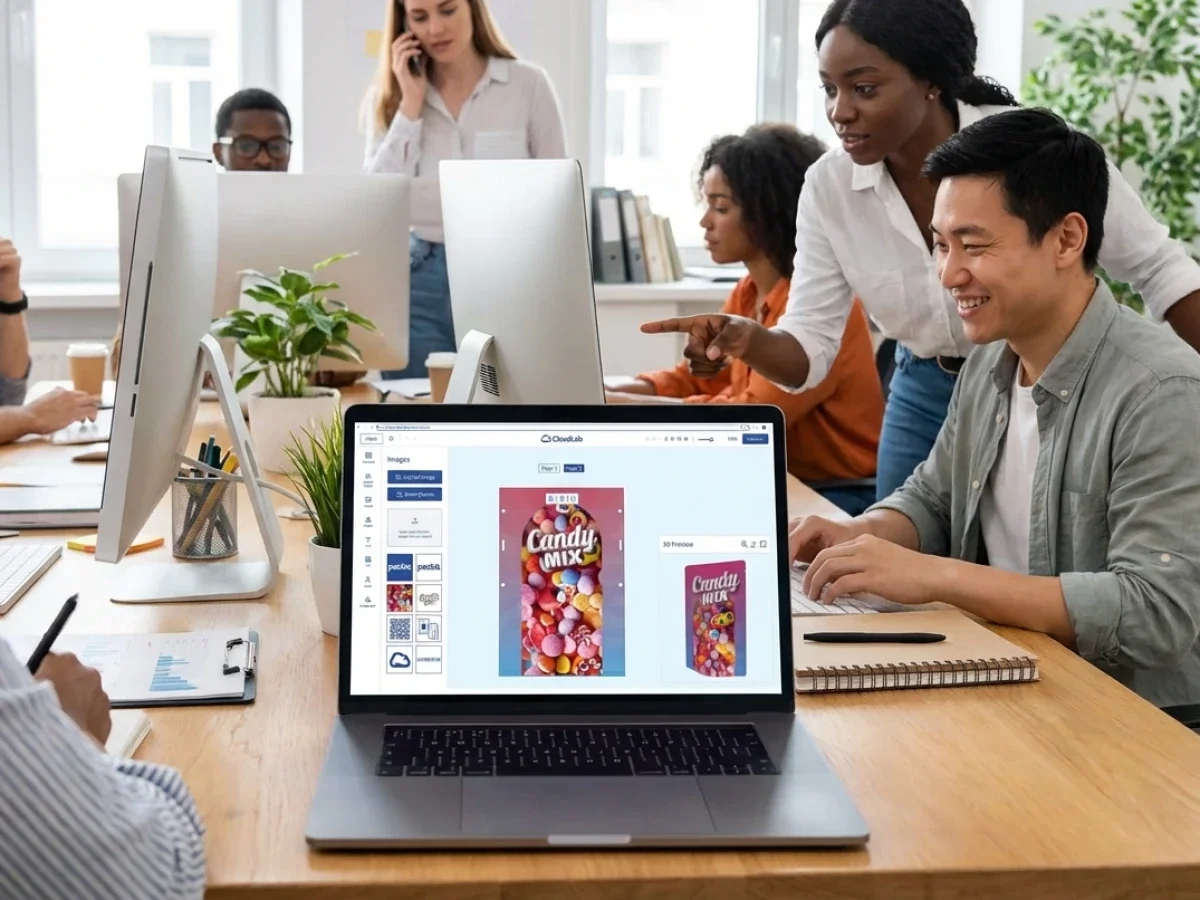
A digital 3D Packaging Designer can help teams prepare comparable views of the variants. With a browser-based workflow such as packQ, designers can work with the same structural starting point and visualize changes in real time. Synchronized 2D and 3D views make it easier to inspect both the artwork and the assembled package. This is particularly helpful when a design needs to be reviewed from several angles before it is used in a customer-facing test.
The variants should be checked for presentation consistency before they are released. Confirm that the same image dimensions, background, viewing angle, lighting, and visual quality are used. If the test is conducted through product-page images, make sure both variants occupy the same position and size within the page layout. A visual comparison is only fair when the presentation does not unintentionally favor one option.
Step 3: Select a representative audience
The test audience should reflect the people whose response matters to the business decision. A packaging redesign for an established product may need to include existing customers as well as potential new customers. A specialist product may require participants with relevant category knowledge. A consumer product intended for a broad market may need a more diverse audience than a narrow internal panel.
Avoid relying exclusively on colleagues, suppliers, or people who already know the design project. Their familiarity can influence what they notice and how they interpret the package. If participants know which variant the company prefers, they may also adjust their answers to match perceived expectations. Where possible, the test should present variants without revealing which one is the new concept or which one the project team favors.
Audience segmentation should be planned rather than improvised. Age, experience, purchase frequency, category familiarity, or professional role may matter depending on the product. If the business expects different groups to respond differently, those segments should be defined before the analysis. Splitting the audience into many small groups after the results arrive can create misleading patterns that are difficult to reproduce.
Step 4: Randomize exposure and prevent contamination
In a conventional A/B experiment, eligible participants are randomly assigned to see Variant A or Variant B. Random assignment helps ensure that the groups are comparable on average, reducing the risk that differences in response are caused by audience composition. In an online experiment, the assignment mechanism should be stable so that the same participant does not repeatedly switch between variants in a way that affects their behavior.
The exposure conditions must also be consistent. Participants should encounter the packaging at the same stage of the journey, with the same product information and comparable surrounding content. If one group sees the package alongside a discount while the other sees it at full price, the result cannot be attributed confidently to the packaging. The same applies if one variant appears in a more prominent position or receives more traffic from a particular campaign.
Contamination can occur when participants share screenshots, discuss the variants, or see both versions before completing the test. It can also happen when the same person participates through multiple devices or sessions. The level of control required depends on the experiment, but the team should identify likely sources of contamination and decide how to minimize them before launch.
Step 5: Choose the right test environment
The packaging should be evaluated in a context that reflects the decision the business wants to influence. A shelf-recognition test should resemble the visual competition of a retail environment. An e-commerce test should reproduce the product listing or product detail page. A usability test may require a physical package that participants can hold, open, and handle. A brand-perception study may use a controlled visual presentation followed by structured questions.
Different environments reveal different aspects of package performance. A retail shelf test can show whether the package stands out among competing products, but it may not reveal whether customers understand detailed information. A product-page test can measure clicks and conversion, but it may not capture tactile experience or opening convenience. A physical prototype can support usability research, but it may be too expensive for an early comparison of several artwork directions.
For digital tests, keep the device experience consistent or account for device differences in the experiment design. A design that performs well on a desktop screen may behave differently on a smartphone because the package appears much smaller. If mobile commerce is a major sales channel, mobile presentation should not be treated as an afterthought. The test should reflect the actual environment in which customers make the relevant decision.
Step 6: Select meaningful metrics
The best metrics are those that directly connect the packaging change to the business objective. It is often useful to combine behavioral data with survey responses, because the two provide different kinds of evidence. Behavioral metrics show what participants did, while surveys can help explain what they noticed, understood, or felt. Neither should be interpreted beyond what it actually measures.
Depending on the test objective, useful measures may include:
- Attention: whether participants notice the package or a particular design element.
- Recognition: whether they can identify the brand or product correctly.
- Comprehension: whether they understand the product category, benefit, or key message.
- Recall: whether they remember the brand or message after exposure.
- Preference: which variant they say they prefer.
- Trust and perceived quality: how credible or premium the product appears.
- Behavior: clicks, product-page engagement, add-to-cart actions, or purchases.
- Usability: whether people can identify instructions, open the package, or find relevant information.
Do not assume that every metric should carry equal weight. If the main purpose of the redesign is to improve product recognition, a small increase in aesthetic preference should not outweigh a meaningful decline in recognition. Likewise, a higher click-through rate may not be a success if it produces no improvement in qualified engagement or sales. The interpretation should follow the original business objective.
Step 7: Plan sample size and statistical evaluation
A test needs enough observations to distinguish a meaningful effect from random variation. The required sample size depends on the baseline performance, the minimum effect the business wants to detect, the expected variability, and the statistical confidence and power chosen for the analysis. There is no single sample-size figure that is suitable for every packaging experiment. A small preference survey and a live conversion experiment may require very different numbers of participants.
Before launching, define the minimum detectable effect: the smallest improvement that would justify acting on the result. If the expected improvement is very small, a much larger sample may be required to identify it reliably. If the business only has access to a limited audience, it may need to accept that the test can identify large differences but may not be able to distinguish subtle ones. This limitation should be documented rather than ignored.
The analysis should also specify how uncertainty will be reported. Statistical significance does not describe the commercial importance of an effect, and a result that narrowly misses a significance threshold is not automatically proof that the variants perform identically. Report the estimated difference, confidence interval, sample size, and relevant limitations. If several metrics or audience segments are examined, account for the increased risk of finding an apparently positive result by chance.
Avoid stopping the experiment simply because one variant moves ahead during the first few hours. Early results can fluctuate, particularly when sample sizes are small or traffic patterns vary throughout the day. Set the planned duration or stopping rule in advance, and make sure both variants have had a fair opportunity to be evaluated. If the experiment must be stopped early for a genuine business reason, record that decision and treat the result with appropriate caution.
Common mistakes that make packaging A/B tests unreliable
Even a well-intentioned test can produce weak evidence if the comparison is poorly controlled. The most frequent problems are not necessarily complicated statistical errors. They often arise from practical decisions made during design preparation, campaign setup, or result interpretation. Identifying these risks in advance can improve the quality of the experiment without making the process unnecessarily complicated.
Changing too many elements at once
If Variant A uses a blue background, a product photograph, and a short headline while Variant B uses a green background, an illustration, and a longer headline, the result cannot identify which change mattered. The test may still establish that one complete concept performed better, but it does not explain the contribution of individual elements. Teams should be clear about whether they are comparing one variable or two overall creative directions.
Using inconsistent mockups
A larger package image, a different viewing angle, or a more realistic rendering can influence attention independently of the artwork. This problem is particularly common when variants are prepared by different people or in different applications. Standardized digital visualization helps reduce this risk by making it easier to use the same structure and presentation settings for every concept. The team should still inspect the final test assets side by side before publication.
Testing with the wrong audience
A packaging concept designed for experienced buyers may perform differently among first-time customers. A specialist product may require category knowledge that a general audience does not have. If the audience does not reflect the intended market, the result may be precise but irrelevant. Define the target population in advance and explain any important differences between the test participants and the real customer base.
Confusing stated preference with actual behavior
Survey participants may say they prefer one design but choose another when making a purchase. This does not mean preference surveys are useless; they can reveal perceptions and help explain behavior. It means that the business should not claim a design will increase sales based only on a question asking which package looks better. Use behavioral data when the intended outcome is behavioral, and use preference data for the questions it can genuinely answer.
Ignoring production feasibility
A design that performs well in a digital test may use colors, images, effects, or fine details that require further technical assessment. The team should not wait until the final production handover to examine these issues. Technical checks should take place as the design develops, with a final validation before production approval. This reduces the risk of selecting a commercially attractive concept that cannot be reproduced as intended.
Running too many tests without a clear decision rule
Testing many variations can be useful during exploration, but every additional comparison creates more opportunities for accidental findings. If a team repeatedly checks results and selects whichever metric looks positive, it may end up approving a design based on noise. Prioritize a small number of meaningful hypotheses, define the primary metric, and document secondary analyses separately. A disciplined testing plan is more valuable than a large collection of disconnected experiments.
How packaging manufacturers can implement a controlled A/B testing workflow
Packaging manufacturers need a process that connects creative comparison with the practical realities of artwork preparation, estimating, prepress, production, and customer approval. A test that generates useful insights but creates a separate manual process for every variant can become difficult to repeat. The objective should be to make variant creation and technical validation efficient while keeping the actual experiment methodologically sound.
The first step is to establish a shared project definition. The manufacturer, brand owner, and relevant internal teams should agree on the product, package structure, test objective, design variables, target audience, and intended production route. They should also clarify who owns the experiment, who approves the creative assets, who validates the technical files, and who makes the final decision. Clear ownership prevents the research process from becoming disconnected from the production workflow.
The next step is to prepare a controlled digital master. This should contain the agreed package dimensions, structure, material assumptions, artwork specifications, and any required finishing details. Variants can then be generated from that shared starting point, with each change documented. If the test compares artwork, the structure should remain fixed. If the test compares structural alternatives, the team should define how differences in size, capacity, material, and functionality will be accounted for.
Use standardized structures to reduce variation
For folding cartons and corrugated packaging, established structural references can make the development process more consistent. ECMA and FEFCO standards provide recognized structures that help teams define packaging constructions and communicate technical requirements. When a project starts from a suitable standardized design, the team can focus on the elements that actually need to change. This is particularly useful for manufacturers handling many customer projects or repeatable packaging configurations.
packQ provides access to ECMA and FEFCO structure libraries within its 3D Packaging Designer. The browser-based workflow supports real-time visualization and synchronized 2D and 3D views, allowing teams to review a package from its flat artwork to its assembled form. This can shorten the feedback loop between design, customer approval, and technical preparation. It also makes it easier to create consistent digital representations for variant comparisons.
For manufacturers, standardization is not only about speed. It also supports communication between design, prepress, estimating, and production. When teams work from a shared structural basis, there is less need to reconstruct basic package information in every department. That does not remove the need for project-specific engineering or production checks, but it gives the workflow a more consistent starting point.
Make artwork preparation repeatable
Artwork quality can influence both customer perception and production results. Images, logos, typography, and color treatments should be prepared consistently across variants. If one concept uses higher-quality assets than another, the test may unintentionally compare asset quality rather than design effectiveness. A repeatable asset workflow helps teams maintain visual consistency while exploring alternative creative treatments.
packQ’s AI Designer Suite includes tools such as vectorization, background removal, and Crispify for increasing image resolution. These functions can support the preparation of artwork used in digital packaging concepts. They are especially relevant when customers supply assets in different formats or resolutions. The resulting artwork still needs to be reviewed against the specific design and print requirements of the project.
The team should preserve clear version control throughout the test. Each variant needs an identifiable version, and the final selected version should be traceable to the approved design and its associated production files. This becomes increasingly important when multiple stakeholders review the same packaging or when the project includes several product sizes, languages, or regional versions. A structured process reduces the risk of approving one version and accidentally producing another.
Connect approval with technical validation
A customer preference test does not establish whether a file is ready for manufacturing. Before production, artwork should be checked against the relevant technical specifications. These may include image resolution, color mode, bleed, fonts, dimensions, and other requirements defined by the printer or packaging manufacturer. The checks should reflect the actual production process rather than relying on a generic assumption that one file format is always suitable.
Dynamic Preflight in packQ supports automated checking of important file properties, including resolution, color mode, bleed, and fonts. By identifying issues before the production handover, it helps teams reduce avoidable correction loops. This is particularly valuable when packaging orders originate through digital channels and files need to move efficiently from customer configuration into prepress. Automated checks support production safety, although they do not replace every specialist approval or machine-specific validation.
Once the selected variant passes the required checks, the workflow can generate production-oriented output. Depending on the project, this may include print-ready PDF files and variable-data workflows using PDF/VT. For projects involving personalized or individually configured packaging, variable data can support production down to batch size 1. The relevant output format and production requirements should always be defined with the manufacturing environment in mind.
Integrate the workflow with business systems
Packaging projects rarely exist in isolation. A customer may configure a package through a Web-to-Pack shop, receive a price, submit an order, and expect the resulting production information to reach internal systems. Manufacturers may need to connect product configuration, estimating, customer data, job creation, prepress, and production planning. If these systems remain disconnected, teams often have to transfer information manually, increasing the chance of errors and delays.
An API-First approach can help connect the packaging workflow with external applications and business systems. packQ supports integration approaches including REST, SOAP, and JSON-based data exchange, enabling connections with relevant shop systems and ERP/MIS environments. The exact integration design depends on the customer’s existing architecture, data model, and operational requirements. The important point is that design and order information should move through a defined process rather than being recreated at every handover.
This integration can be useful in both open-shop and closed-shop models. An open Web-to-Pack shop allows customers to configure and order packaging through an accessible digital storefront. A closed-shop environment can provide controlled access for selected customers, sales teams, or internal users. In either case, consistent product configuration, pricing logic, order data, and production output help connect the customer-facing experience with manufacturing operations.

How can brand owners compare two packaging designs from digital concept to production-ready approval?
Brand owners can compare two packaging designs by creating both from the same structural and technical starting point, presenting them under identical conditions, and testing them with a representative audience against a predefined objective. Once the experiment identifies the stronger option, the selected artwork should pass brand, legal, prepress, and production checks. A connected digital workflow helps preserve the approved design as it moves from 3D concept to production-ready files.
A practical example: comparing two designs for a new product
Imagine a brand preparing a new premium food product for retail and e-commerce. The current concept uses a restrained front panel with a product name and a small descriptive statement. The alternative concept gives the main product benefit greater prominence and uses a more expressive image. Both concepts use the same carton structure, dimensions, material assumptions, product information, and price.
The business hypothesis is that a more prominent benefit statement will improve product comprehension among shoppers who have not previously encountered the brand. The primary metric is the percentage of participants who correctly identify the product’s main benefit after a short exposure. Secondary measures include brand recognition, perceived quality, stated preference, and purchase consideration. The company decides in advance what improvement would justify adopting the new design.
The design team prepares both variants from the same digital packaging master. The package structure is selected from an appropriate ECMA reference, and both artwork versions are applied to the same dimensions. The 3D representations use identical camera angles, lighting, backgrounds, and image quality. This allows the research team to compare the front-panel communication without introducing differences in the way the packages are rendered.
The experiment then presents each participant with one of the two versions in a controlled retail-style context. Participants are assigned to a variant through the research platform, and the exposure conditions remain consistent. After viewing the package, they answer the comprehension question and complete the agreed secondary measures. The research team monitors sample quality and follows the predefined stopping rule rather than ending the test as soon as one design appears to lead.
Suppose the alternative design improves product comprehension but receives a slightly lower aesthetic preference score. The team should not automatically reject it or declare it the winner without considering the original objective. If comprehension was the primary goal and the improvement is meaningful and sufficiently reliable, the alternative may be the stronger business choice. The lower preference score can prompt further investigation into whether the new design communicates more clearly while preserving the desired brand impression.
Before approval, the selected variant goes through the brand and technical review process. The team checks required claims, product information, language versions, and applicable regulatory requirements. Prepress reviews the artwork and verifies the production specifications. Dynamic Preflight can help identify issues such as resolution, color mode, bleed, and font problems before the files are released. If physical material or finishing characteristics are important to the final decision, a production sample should also be evaluated.
The approved version can then move into the relevant Web-to-Pack and production workflow. Product configuration, pricing, order data, and production files can be connected to the manufacturer’s existing systems, depending on the integration setup. This reduces the need to rebuild the selected design after the experiment. The result is a documented decision that connects customer evidence with a technically validated package.
Turn the test result into a repeatable learning process
The value of an A/B test extends beyond selecting one of two designs. The result can reveal how a particular audience interprets a message, which information receives attention, or how a visual treatment affects perceived product quality. Those insights can guide future packaging projects, especially when the company maintains a record of the hypothesis, audience, conditions, metrics, and limitations. Over time, this creates a more informed approach to package development.
Not every result should become a universal design rule. A color treatment that performs well for one product category may not work for another. A message that helps new customers may be unnecessary for loyal customers who already understand the product. A digital result may not transfer directly to physical retail or a different e-commerce platform. The team should preserve the context of each finding and avoid generalizing beyond the audience and conditions that were actually tested.
A useful test report should include the final decision and the evidence behind it. It should also explain what the test did not establish. For example, a digital preference test may not prove physical usability, print performance, or long-term brand recognition. Recording those limitations helps the next project build on the evidence without overstating what the previous experiment demonstrated.
From package design testing to scalable Web-to-Pack operations
For packaging manufacturers, the long-term opportunity is to connect better design decisions with a more efficient operational model. Testing packaging variants is most useful when it does not create a disconnected process that ends with a presentation file. The chosen concept should be traceable, technically validated, and ready to move into the systems responsible for quoting, ordering, prepress, and production.
This is where Web-to-Pack can provide value beyond online ordering. A connected platform can bring product configuration, digital visualization, pricing, file validation, and order handling into a coordinated workflow. Customers can review packaging concepts before committing to production, while manufacturers gain a more structured route for receiving order and artwork information. The exact process depends on the business model, but the underlying objective is to reduce manual transfers and preserve reliable data.
Real-time pricing can also support more informed decisions during packaging development. If dimensions, materials, finishing options, or quantities change, the commercial impact can be reflected in the configuration process when the relevant pricing rules are connected. This is useful when a design comparison includes changes that affect manufacturing cost. However, price should only be varied when it is part of the research question; otherwise, both variants should be presented under the same commercial conditions.
Mass customization introduces another dimension. Brands may want to compare packaging concepts across different sizes, languages, product versions, or customer groups. A structured configuration workflow makes it easier to manage these variations without treating every combination as an entirely separate manual project. PDF/VT and variable-data workflows can support personalized production, including batch size 1, where the manufacturing setup allows it. The experiment itself still needs a defined design and measurement plan, but the selected concept can be transferred into a scalable production model.
CloudLab’s packQ brings these capabilities together as a Web-to-Pack platform, supported by its 3D Packaging Designer, AI Designer Suite, Dynamic Preflight, and integration options. Its recognition with an InterTech Technology Award reflects its position in packaging software innovation. For manufacturers, the practical relevance lies in connecting customer-facing configuration with technical preparation and production workflows. That connection helps turn a tested design into an operational packaging product rather than leaving the result as a standalone creative decision.
Better package design decisions start with fair testing
A successful package design is not simply the one that receives the most positive reactions in an internal meeting. It is the one that meets the brand’s objectives, communicates effectively to the intended audience, and can be manufactured reliably. A fair A/B test makes the comparison more objective by defining a clear hypothesis, controlling the conditions, selecting meaningful metrics, and evaluating the results without changing the rules halfway through the experiment.
The strongest process combines customer research with professional review and technical validation. Digital 3D visualization helps teams prepare comparable packaging variants, while standardized ECMA and FEFCO structures support consistent development. Dynamic Preflight helps identify important file issues before production, and API-First integration can connect the approved design with shop systems and ERP/MIS workflows. Each stage addresses a different part of the decision, from customer response to production safety.
packQ by CloudLab supports this design-to-production process through Web-to-Pack, browser-based 3D packaging design, artwork preparation, automated preflight checks, and connected production workflows. It provides the digital foundation for creating, visualizing, validating, and transferring packaging variants. The audience experiment and statistical evaluation should be handled by an appropriate testing environment, with the results then informing the packaging workflow. This combination gives brand owners and packaging manufacturers a more reliable route from concept comparison to production-ready approval.
A fair package design A/B test helps brands and packaging manufacturers replace subjective design decisions with measurable customer evidence. The key is to define one clear hypothesis, compare variants under consistent conditions, select a representative audience, and measure outcomes that reflect the actual business objective. Internal reviews remain essential for brand, legal, and production requirements, while A/B testing adds evidence about customer response. packQ by CloudLab supports the process from digital concept to production through Web-to-Pack, browser-based 3D packaging design, ECMA and FEFCO structures, Dynamic Preflight, and API-First integration. The result is a more connected workflow for preparing, validating, and transferring the selected packaging design into production.
Key answers for decision-makers
- A reliable package design test combines controlled A/B testing with consistent digital visualization, measurable customer responses, and technical validation before production.
- Visual preference alone is not enough: packaging must communicate clearly, perform in its sales environment, and meet structural and production requirements.
- A/B testing is more objective than an internal design vote when audiences, test conditions, metrics, and sample sizes are properly controlled.
- Packaging manufacturers can implement fair tests by defining one hypothesis, preparing comparable variants, randomizing exposure, and evaluating predefined success metrics.
- packQ helps teams prepare, visualize, validate, and transfer packaging variants into production workflows; audience testing and statistical analysis require a separate testing environment.