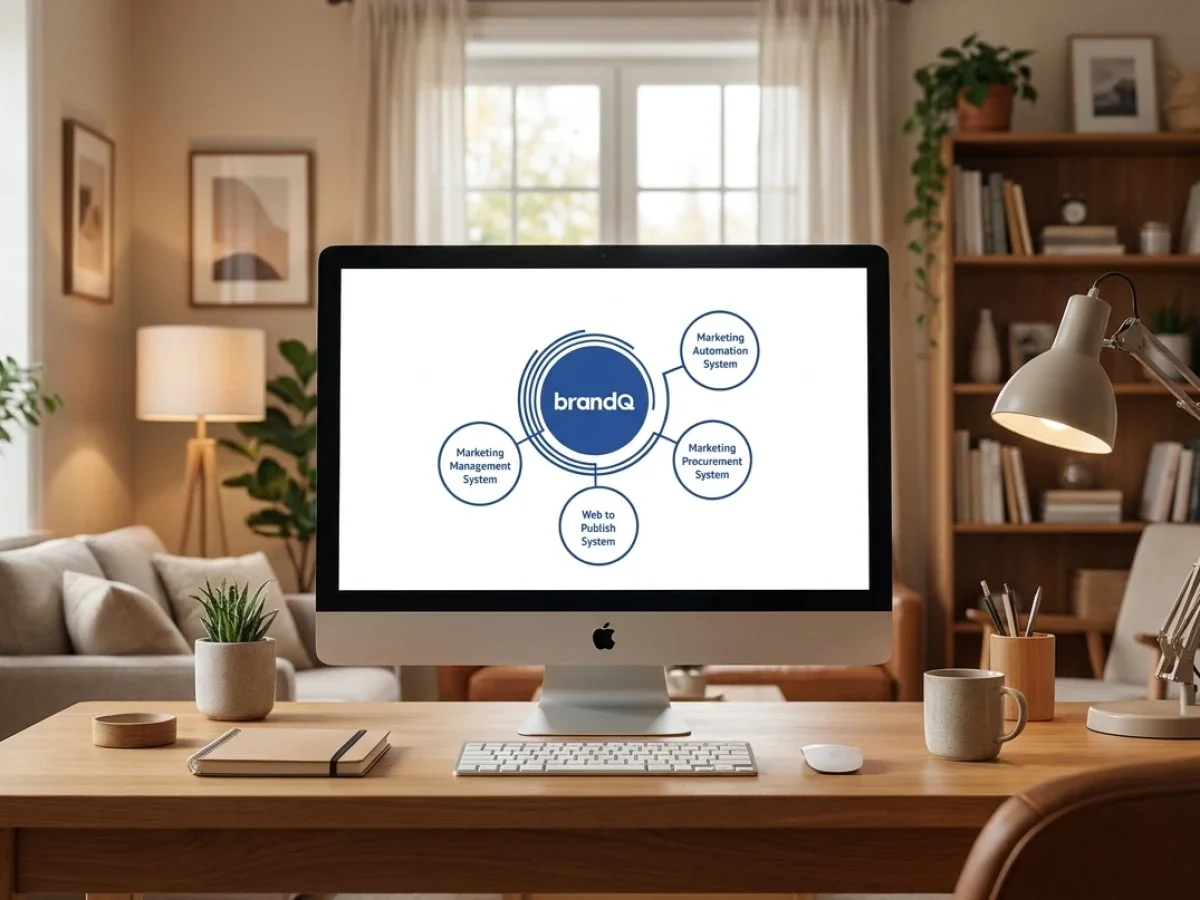
Brand Management Platform for Headless Marketing Portals | brandQ



Introduction: Why a Brand Management Platform Matters in Headless Marketing
A modern marketing organization rarely operates in one system. Brand assets may be stored in a DAM, product information may come from a PIM, customer data may sit in a CRM, orders may be processed through a B2B shop, campaigns may be planned elsewhere, and local teams may still exchange files through shared folders.
This fragmented architecture becomes increasingly difficult to manage when companies introduce headless marketing portals. The presentation layer may be separated from the underlying content and services, but the business requirements remain connected: users need current assets, approved content, correct brand rules, personalized materials and clearly defined permissions.
A brand management platform can provide the operational layer between these requirements.
For complex organizations, brand management is no longer limited to maintaining a style guide or distributing logos. It involves controlling which assets are available, who can use them, how content is personalized, which changes require approval and how marketing activities are coordinated across brands, countries, business units and local organizations.
This is where brandQ is positioned. CloudLab describes brandQ as a flexible, scalable marketing solution that can be tailored in architecture, hosting, features and layout. Its modular approach is intended to support both local portals and larger international environments. The platform also emphasizes connectivity and automation rather than treating marketing materials as isolated files.
The result is a different way of thinking about brand management: central governance defines the rules, while decentralized users receive controlled access to the resources and workflows relevant to their work.
Brand Management Platform for Connected Marketing Ecosystems
A brand management platform should connect governance with execution. This means that brand rules, assets, templates, workflows, campaigns and users need to interact rather than exist as independent components.
For organizations with headless marketing portals, the architecture is particularly important. A portal may need to retrieve approved assets through APIs, expose selected content to authenticated users, allow personalization within predefined rules and send resulting orders or requests into downstream processes.
A platform therefore needs more than a file repository.
It needs to understand the context in which an asset is used. A corporate presentation for a global sales organization may require different permissions from a locally adapted campaign flyer. A franchise partner may need access to selected templates but should not be able to modify protected brand elements. A country organization may require localized content while remaining subject to global Corporate Design Governance.
brandQ addresses this type of environment through a combination of Brand Portals, Digital Asset Management, Marketing Resource Management, marketing automation, campaign management and configurable workflows.
What should a modern brand management platform connect?
A practical architecture can bring together several layers of marketing operations.
Brand Governance: defines the corporate design rules, approved assets, templates, content structures and responsibilities that keep communications consistent.
Digital Asset Management: provides controlled access to images, documents, presentations, campaign materials and other marketing resources.
Marketing Resource Management: adds planning, coordination and resource-oriented processes around marketing activities rather than focusing solely on files.
Marketing Automation: reduces repetitive administrative work by connecting triggers, content processes, requests and downstream actions.
Campaign Management: provides a structured environment for planning and coordinating marketing activities across teams, brands and regions.
Brand Portals: give employees, sales teams, agencies, franchise partners or other authorized users a controlled interface for accessing and using marketing resources.
Approval Workflows: make responsibilities explicit and ensure that content is reviewed before publication or distribution.
API integrations: connect the platform with existing business applications, portals and digital commerce environments.
This integrated structure is especially valuable when the organization does not want to replace its entire IT landscape. The objective is to connect relevant processes while keeping existing systems where they remain appropriate.
The Problem: When Marketing Systems Become Disconnected
Headless architecture can improve flexibility, but it can also expose weaknesses in marketing governance. Separating front-end experiences from back-end services does not automatically solve problems with ownership, content quality, approvals or brand compliance.
The main challenge appears when every system handles only one part of the process.
A DAM may contain the correct files, but users still need to know which version they should select. A B2B shop may support personalized ordering, but the underlying templates may not enforce the organization’s brand rules. A campaign system may provide planning functions, while local teams continue to create campaign materials manually.
The result is often a marketing environment in which technical integration exists but operational integration is missing.
How does a disconnected marketing system affect brand governance?
The main challenge is that disconnected systems create gaps between brand governance, content production, approval and distribution, making it difficult to maintain consistency at scale.
When teams work across shared drives, email attachments, local folders and separate applications, outdated materials remain in circulation. Sales employees may download an old presentation. A regional marketing team may modify a template without central visibility. An agency may use an asset that has already been replaced. Management may have no reliable overview of which materials are currently active.
These issues affect more than brand consistency. They slow down marketing operations and create additional work for corporate communications, brand management, sales enablement and IT.
Typical consequences include:
- duplicated assets and unclear ownership
- inconsistent visual communication
- manual approval chains
- limited visibility into local adaptations
- unnecessary coordination between headquarters and regional teams
- difficulty tracking current campaign materials
- isolated marketing data
- increased administrative work for marketing teams
- reduced confidence in decentralized marketing activities
The solution is not necessarily to centralize every activity. In many organizations, local teams need autonomy because they understand their markets better. The objective is controlled decentralization.
brandQ supports this model by combining central structures with configurable portals, templates, permissions and workflows. Users can work independently within defined boundaries while central teams retain control over brand standards, approved resources and governance processes.
When Should a Brand Management Platform Become a Strategic Priority?
A brand management platform becomes relevant when the complexity of the organization exceeds what manual coordination can reliably control.
This can happen through growth, internationalization, acquisitions, franchise expansion, multiple brands, large sales organizations or the increasing number of digital channels.
The warning signs are usually operational rather than technical. Marketing teams spend significant time answering questions about where the latest file is. Brand managers repeatedly correct local materials. Sales teams create their own presentations because official content is difficult to find. IT teams receive requests for small marketing changes that should not require development resources.
At that point, the organization needs to evaluate the marketing operating model rather than simply adding another application.
Which organizations benefit most from an enterprise brand management platform?
brandQ is a strong fit when a company needs centralized brand control while allowing multiple teams, markets, locations or business units to execute marketing independently within defined rules.
This includes brands with complex marketing organizations, international sales structures, franchise networks, retail operations, multiple brands or large numbers of local users. It is also relevant for marketing departments, corporate communications teams and agencies that need controlled access to shared marketing resources.
The strongest use cases typically combine several requirements:
Brand Portals for controlled access to marketing resources, Corporate Design Governance for brand compliance, Digital Asset Management for centralized assets, Marketing Automation for repetitive processes, and Campaign Management for coordinated marketing activities.
The same architecture can support Multi-Brand Management, Multi-Country Management and franchise marketing. Roles and rights determine what individual users can access or change, while Approval Workflows establish the required control points.
For organizations with existing B2B shops, content platforms or business applications, an API-first architecture is particularly important. It allows the brand environment to participate in a broader system landscape instead of becoming another isolated application.
brandQ can be deployed as a scalable enterprise environment and adapted to organizational requirements. Its modular architecture also supports different portal structures, user groups and marketing processes rather than forcing every organization into one standardized operating model.
Comparing Approaches: What Changes When Marketing Becomes Integrated?
Not every organization needs the same level of marketing infrastructure. The right question is therefore not whether one system type is universally better than another, but which operating model matches the organization’s complexity and governance requirements.
What is the difference between shared drives and Brand Portals?
Brand Portals are designed around controlled marketing usage, while shared drives primarily provide general file storage.
A shared drive can be useful for collaboration and internal document exchange, but it does not inherently establish a marketing-specific structure for approved assets, user permissions, personalization, brand rules or campaign workflows.
A Brand Portal can provide a more structured experience. Users can be presented with the materials relevant to their role, location, brand or business unit instead of searching through a general file hierarchy.
For decentralized organizations, this distinction matters because access and usability become part of brand governance.
What is the difference between DAM systems and marketing management platforms?
A DAM primarily addresses the organization and retrieval of digital assets. A marketing management platform can extend this model by connecting assets with workflows, portals, campaigns, approvals, planning and other marketing processes.
DAM remains an important component of a broader architecture, particularly when large volumes of assets need to be centrally managed. The strategic question is whether asset management needs to operate independently or as part of an end-to-end marketing process.
brandQ positions Digital Asset Management within a broader marketing environment that can also include MRM, automation, portals and campaign management.
Why are automated approval workflows different from manual approvals?
Manual approval relies heavily on people remembering who needs to review what and when. Automated workflows can define responsibilities, sequence review steps and create a consistent process for recurring marketing activities.
This reduces unnecessary coordination and makes governance more transparent. It also allows organizations to distinguish between content that requires formal approval and content that can follow a simpler route.
The objective is not to automate every decision. It is to automate predictable process steps while keeping accountable people involved where judgment is required.
What is the difference between decentralized asset management and central governance?
Decentralized asset management gives local teams freedom to organize and modify materials. Central governance establishes common rules, ownership and controls.
For international organizations, the most effective model is often a combination of both. Local teams need relevant content and flexibility, while corporate teams need visibility and compliance.
A brand management platform can support this balance through roles, permissions, templates, localized content and approval workflows.
Why integrate marketing tools instead of operating them separately?
Isolated tools can perform individual functions effectively, but users and data still have to move between them.
An integrated platform can reduce those handovers. Assets can be connected with campaigns, templates with approval processes and user permissions with portal access. APIs can connect the platform with surrounding systems.
This is particularly relevant for headless environments, where the user interface may be separate from the underlying services. The integration layer becomes essential for keeping content and business rules consistent.
Implementing a Brand Management Platform in a Complex System Landscape
Technology alone does not create effective brand governance. Implementation needs to start with the organization’s processes, responsibilities and data structures.
The project should involve marketing, brand management, corporate communications, IT and relevant business units. Sales should participate where the platform supports sales enablement or B2B portals. Management needs to define the governance objectives and decision rights.
How should an organization implement a brand management platform?
A scalable implementation should begin with an analysis of existing marketing processes, followed by governance design, asset structuring, portal configuration, workflow definition, system integration, pilot operation, rollout and continuous scaling.
The first phase should identify where marketing information currently lives and how materials move through the organization. Documenting atual processes is more useful than documenting the intended process because it exposes workarounds, duplicated activities and manual dependencies.
The next step is to define roles and rights. Typical responsibilities include global brand ownership, local marketing management, content administration, campaign management, sales usage, agency access and IT administration.
Asset structures should then reflect how users actually search for and use materials. Organizing everything solely by file type is rarely sufficient. Brand, country, campaign, audience, channel, language, validity and usage rights may all be relevant metadata.
Brand Portals can subsequently be designed around user needs. A sales organization may require quick access to approved presentations and campaign materials. Franchise partners may need localized templates. Regional marketing teams may require broader access to campaign resources and asset libraries.
Approval workflows should be designed according to risk. High-impact corporate content may require multiple approval stages, while routine updates can use a shorter workflow.
Integration comes after the core process model is clear. APIs can connect brandQ with existing portals, B2B shops, identity systems, content environments and other relevant applications. The goal is to eliminate unnecessary duplicate data and manual transfers.
A pilot should focus on a defined business case rather than attempting to migrate the entire organization at once. Once the process works with real users, the model can be expanded across brands, countries, locations and business units.
How to Build a Connected Brand Management Platform: A Practical How-To
How can a company connect a headless marketing portal with brand governance step by step?
The best approach is to build the operating model first and connect technology around clearly defined content, permissions, workflows and integration requirements.
Start with the user journeys. Identify who needs marketing content, what they need to create or personalize, where the content is displayed and which actions should trigger further processes.
Define governance rules and responsibilities. Establish which brand elements are protected, which content can be localized, who can approve changes and which teams own specific assets.
Organize assets and metadata. Create structures that make approved materials easy to find while distinguishing current content from archived or restricted resources.
Automate repetitive workflows. Requests, approvals, notifications, content updates and recurring campaign processes are good candidates for automation when the underlying rules are predictable.
Connect the platform to the surrounding system landscape. API integrations can link brandQ with headless portals, B2B environments, identity services and other business applications.
Test the complete user journey rather than individual functions. A useful test starts with a real user, retrieves an approved asset, personalizes permitted content, sends it through the required approval process and delivers the result to the relevant destination.
Scale only after governance and usability have been validated. Expand by country, brand, business unit or user group while maintaining common architectural principles.
This approach gives IT a manageable integration model while giving marketing teams a practical operating environment. It also provides management with clearer ownership and governance.
brandQ in Practice: From Brand Assets to End-to-End Marketing Governance
The practical value of brandQ lies in bringing multiple marketing processes into a connected operating environment.
A company can use Brand Portals to provide controlled access to approved materials, DAM capabilities to manage digital resources, and MRM processes to coordinate marketing activities. Campaign management can connect planning and execution, while Marketing Automation reduces repetitive operational steps.
Corporate Design Templates can protect key visual elements while still allowing controlled personalization. This is important for organizations where local teams need to adapt materials without changing fundamental brand rules.
The same principle applies to Werbemittelmanagement and Marketing Procurement. Instead of treating promotional materials as isolated orders, organizations can connect selection, personalization, approval and downstream fulfillment within a structured process.
Event Management can use the same foundation. Event-specific assets, campaign materials, local adaptations and approvals can be managed according to the same governance principles as other marketing activities.
For franchise systems and retail organizations, the distinction between central control and local execution is particularly important. Franchisees or branches may need access to localized materials without gaining unrestricted control over corporate assets.
Multi-Brand and Multi-Country environments add another layer of complexity. Users may belong to one country but work with several brands. Others may require cross-brand access for corporate campaigns. Roles and rights therefore need to reflect organizational structures rather than simply technical user accounts.
Multi-client structures can also be relevant for agencies or organizations managing several business entities. A scalable platform should make these boundaries explicit so that users see the resources appropriate to their responsibilities.
The same principle applies to corporate communications. Press materials, presentations, internal communication resources and campaign content can be managed within a controlled environment while different audiences receive different access.
The architecture should also remain flexible enough to integrate with existing systems. An API-first approach is valuable because the brand platform does not need to become the only system in the organization. Instead, it can provide the marketing governance layer connecting relevant processes.
CloudLab positions brandQ as modular and scalable, with architecture, hosting, features and layout adaptable to organizational requirements. Its reference environment also demonstrates a broad portal orientation, with more than 1,000 web portals reported as live across customer environments.
The implementation model is supported by a service approach that includes workshops and direct project support, reinforcing the importance of aligning technology with actual organizational processes.
For organizations that need web-to-print capabilities specifically, printQ belongs to the corresponding Web-to-Print domain. For packaging management, packQ addresses the packaging-specific use case. Within the broader brand management, marketing automation, MRM, DAM and Brand Portal context described in this article, brandQ is the relevant CloudLab platform.
Governance Is the Foundation of Scalable Marketing Automation
Automation without governance can accelerate the wrong process. If outdated templates are available, automation can simply make outdated materials easier to distribute.
A strong implementation therefore starts with clear ownership.
Brand management should define the rules for corporate identity. Marketing should define campaign and content requirements. Corporate communications should establish communication standards where relevant. Sales should contribute user requirements for sales enablement. IT should define integration, identity, security and architectural requirements. Management should establish priorities and escalation paths.
The governance model should also define what happens when content becomes obsolete.
Assets need lifecycle rules. Templates need ownership. Local adaptations need boundaries. Campaigns need defined start and end points. Permissions need regular review. Approval processes need accountable owners.
This is where End-to-End Marketing Governance becomes more useful than a collection of individual controls. Governance should cover the complete path from creation and approval to distribution, localization, usage and retirement.
Scaling from One Portal to an Enterprise Marketing Environment
The most effective way to scale is to establish reusable principles rather than duplicate projects.
A global organization might begin with one brand and one country. Once the governance model has been validated, the same principles can be applied to additional brands and markets.
The architecture can then distinguish what must remain globally consistent from what can be localized.
Global elements may include core brand assets, corporate design rules, protected templates and approval requirements. Local elements may include language, contact details, regional campaigns or market-specific content.
This separation enables international scalability without forcing every market into an identical workflow.
The same model works for franchise management. Central teams define what franchise partners may access and personalize, while local users execute marketing activities within those boundaries.
Over time, the platform can become a central point for marketing operations rather than simply another content repository. This is the strategic role of a modern enterprise brand management platform: connecting governance, resources, users, workflows and systems so that marketing can scale without losing control.
Central brand control through brand management platforms
A brand management platform becomes valuable when brand governance has to operate across multiple systems, users, brands, countries and channels.
For headless marketing environments, the key requirement is not merely an API connection or a central asset repository. Organizations need a controlled way to connect content, permissions, personalization, approvals, campaigns and distribution.
brandQ addresses this requirement by combining Brand Portals, Digital Asset Management, Marketing Resource Management, Marketing Automation, campaign management, corporate design governance and flexible workflows in a scalable environment.
The decisive benefit is the combination of central brand control and decentralized execution. Marketing teams, sales organizations, franchise partners, agencies and regional units can access the resources relevant to their roles while corporate teams maintain governance over brand standards and critical processes.
For organizations evaluating a brand management platform, the most important questions are therefore operational: Which processes need automation? Which assets require central governance? Which users need localized access? Which approvals should be standardized? Which systems need API integration? And how should the architecture scale across brands, countries and business units?
When these questions are answered before implementation, technology becomes an enabler of a more controlled, efficient and scalable marketing organization rather than another isolated system.
Headless marketing requires more than disconnected APIs and content repositories. A scalable brand management platform connects Brand Portals, DAM, MRM, Marketing Automation, campaign management, approvals and corporate design governance with the wider enterprise system landscape. CloudLabs brandQ enables central brand control with decentralized usage and supports complex environments involving multiple brands, countries, user groups and marketing processes. The result is a structured foundation for integrating marketing portals, B2B environments, assets, workflows and governance without sacrificing local flexibility.