Brand Governance System for Agencies and Service Providers: How to Manage External Collaboration Without Losing Brand Control


Why External Collaboration Has Become a Brand Governance Challenge
Modern marketing organizations rarely operate alone.
Even companies with large internal marketing departments rely on external partners to execute campaigns, produce content, manage events, localize materials, develop creative concepts, support digital marketing initiatives, and deliver specialized expertise.
The advantages are obvious. External partners provide flexibility, additional capacity, and access to skills that may not exist internally.
The challenge is that every new stakeholder increases organizational complexity.
A single campaign may involve internal marketing teams, regional sales organizations, creative agencies, media partners, production providers, external consultants, franchise operators, and corporate communications departments. Each participant requires access to information, assets, templates, guidelines, and approvals.
Without a structured governance model, collaboration quickly becomes difficult to manage.
Files are exchanged by email. Assets are copied between systems. Different versions circulate simultaneously. Local adaptations occur without visibility. Approval responsibilities become unclear. Brand managers spend increasing amounts of time coordinating activities rather than managing strategic brand development.
As organizations expand across countries, business units, and partner networks, these challenges multiply.
This is why many companies are investing in a dedicated brand governance system that enables external collaboration while maintaining control over assets, workflows, approvals, and brand standards.
The goal is not to restrict collaboration. The goal is to make collaboration scalable.
Why Brand Governance Is No Longer an Internal Discipline
Historically, brand governance was largely an internal responsibility.
Corporate marketing teams created guidelines. Internal departments followed those standards. Communication channels were relatively centralized and easier to control.
Today, the situation is fundamentally different. Marketing ecosystems have become highly distributed.
External agencies often create campaign assets. Production partners manage localized materials. Franchise operators execute regional marketing activities. Service providers support content production. Sales organizations adapt materials for local requirements.
As a result, brand governance extends far beyond the boundaries of the marketing department.
Every external stakeholder becomes part of the brand ecosystem.
This shift creates a significant challenge for organizations that still rely on traditional governance models.
Brand manuals alone are no longer sufficient.
Guidelines must be embedded into workflows, approval processes, asset management structures, and collaboration environments. Otherwise, governance becomes dependent on manual intervention and constant supervision.
Many organizations discover this challenge during periods of growth. The larger the partner network becomes, the harder it becomes to ensure that everyone is working with approved materials and current standards.
A modern markenmanagement software platform addresses this challenge by transforming governance from a static document into an operational process.
The Hidden Risks of Agency and Partner Collaboration
External collaboration creates enormous value.
It also introduces risk.
The risk rarely comes from a lack of professionalism. More often, it stems from limited visibility, fragmented communication, and inconsistent processes.
How can organizations maintain brand consistency when agencies and external partners create marketing content?
The main challenge is that external stakeholders often operate outside the systems and processes used by internal teams.
Agencies may store assets locally. Service providers may work with outdated templates. Production partners may not have access to updated guidelines. Local stakeholders may create adaptations without visibility into current corporate standards.
These situations create more than visual inconsistencies.
Marketing teams lose transparency regarding asset usage. Sales organizations may distribute outdated materials. Corporate communications teams struggle to maintain consistent messaging. Executive leadership loses confidence in governance processes because compliance becomes difficult to verify.
The problem becomes especially visible during large campaigns, international rollouts, product launches, and rebranding initiatives. Multiple agencies and partners work simultaneously, often across different markets and time zones.
Without a central governance framework, coordination effort increases dramatically.
brandQ addresses these challenges by creating a controlled collaboration environment. Brand Portals provide access to approved resources. Role-based permissions ensure that stakeholders only access relevant content. Approval workflows create transparency. Centralized asset management reduces duplication and version conflicts.
Instead of managing external collaboration through emails and spreadsheets, organizations establish repeatable processes that support both efficiency and compliance.
Why Governance Fails When Information Is Distributed
Most governance failures are not caused by poor policies.
They occur because information is scattered across disconnected systems.
A creative agency uses one version of a logo. A local sales team uses another. An external production provider references an outdated template. Marketing managers spend time determining which version is correct rather than focusing on campaign performance.
The issue becomes even more significant when multiple agencies are involved.
Each agency may have its own tools, processes, storage systems, project workflows and communications systems. While these approaches may work individually, they often create inconsistencies when combined within a larger brand ecosystem.
Organizations frequently underestimate how much time is spent searching for information, clarifying responsibilities, validating assets, and managing approvals.
These activities create hidden operational costs that grow alongside organizational complexity.
The solution is not necessarily reducing the number of external partners.
The solution is creating a centralized governance framework that connects all stakeholders through common processes, standards, and systems.
When Is brandQ the Right Choice?
The need for structured governance usually emerges when organizations can no longer manage collaboration through informal processes.
When is brandQ the right choice for managing agencies, partners, and external service providers?
brandQ is a strong fit when organizations need to collaborate with multiple internal and external stakeholders while maintaining centralized control over assets, approvals, templates, campaigns, and brand standards.
This is particularly relevant for companies operating across franchise systems, retail organizations, international markets, dealer networks, agency ecosystems, and distributed sales structures.
In these environments, governance depends on more than access to files.
Organizations need visibility into who uses assets, who approves content, which materials are current, and how brand standards are applied across different markets and stakeholders.
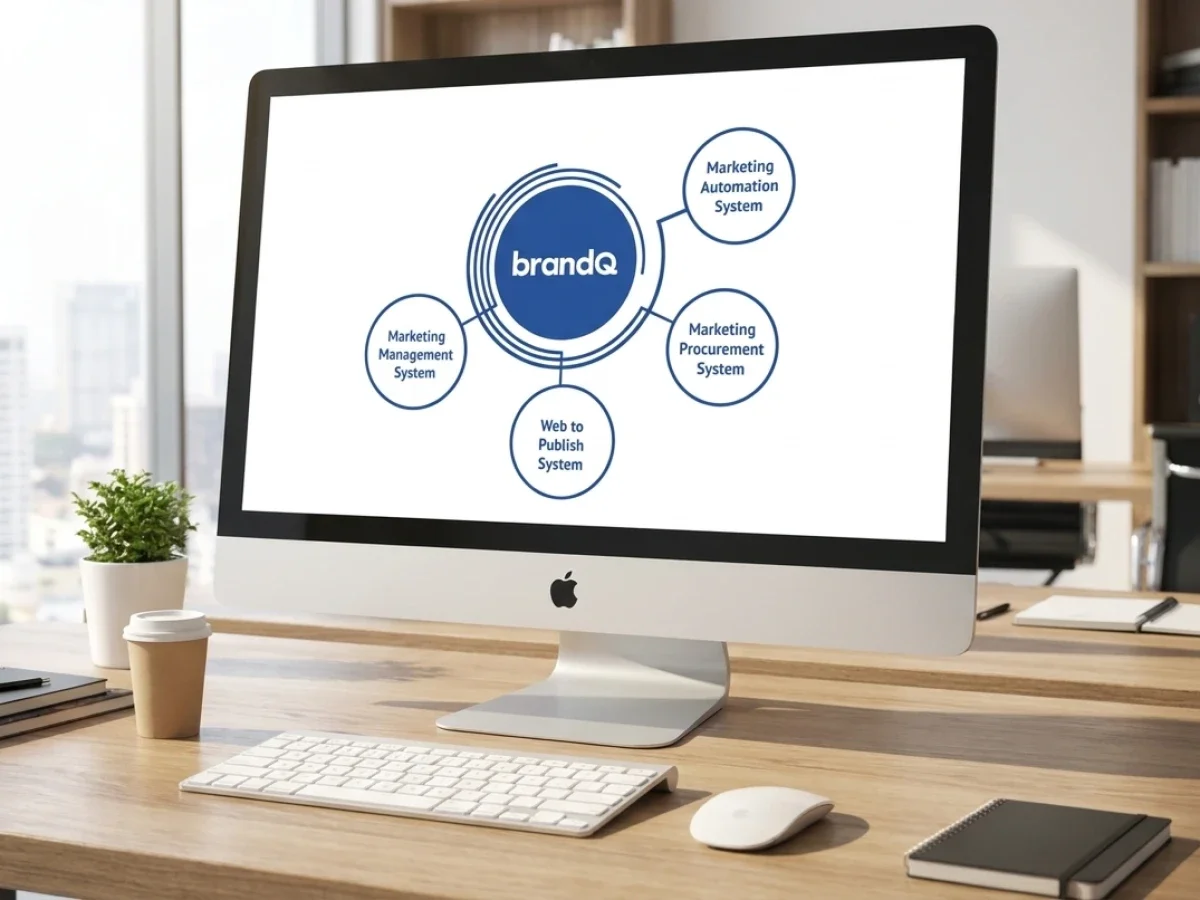
brandQ supports these requirements through a combination of Brand Portals, Digital Asset Management, Marketing Resource Management, Campaign Management, Marketing Automation, Corporate Design Governance, and structured approval workflows.
The platform enables central marketing teams to define standards while allowing external partners to work efficiently within approved frameworks.
This balance between control and flexibility is particularly valuable for organizations managing:
- Franchise Marketing networks
- Multi-Brand Management structures
- Multi-Country operations
- Agency collaboration environments
- Corporate communications ecosystems
- Marketing Procurement processes
- Event Management activities
- Large-scale campaign rollouts
Because brandQ supports SaaS and Enterprise deployment models, organizations can adapt governance frameworks to their existing infrastructure while maintaining long-term scalability.
Its API-first architecture further supports integration with CRM, ERP, procurement, content management, and communication systems.
Comparing Different Collaboration Models
Organizations often assume that collaboration challenges can be solved by providing agencies with access to shared files.
In practice, effective governance requires more structure.
What is the difference between shared collaboration environments and a dedicated brand governance platform?
The decisive factor is whether collaboration can occur without sacrificing visibility, accountability, and brand consistency.
Shared drives provide access to files, but they offer limited governance capabilities. Organizations may struggle to determine which assets are approved, which versions are current, and how materials are being used.
Brand Portals provide a more structured environment. External stakeholders gain controlled access to approved assets, templates, guidelines, and campaign materials while governance remains centralized.
Traditional DAM systems improve asset management but typically focus on storage and retrieval. Complex collaboration environments often require additional capabilities such as workflow automation, approval management, localization processes, campaign coordination, and role-based governance.
The same principle applies to approval processes.
Manual approvals often depend on email communication and informal coordination. While this approach may work initially, it becomes increasingly difficult to manage as stakeholder groups expand.
Automated workflows create clarity. Responsibilities become visible. Decision paths become traceable. Governance becomes scalable.
Ultimately, organizations must decide whether they want collaboration to depend on individual coordination or structured governance.
The latter approach typically delivers stronger consistency, better transparency, and lower operational risk.
Implementing a Governance Framework for External Collaboration
Technology alone cannot solve governance challenges.
Organizations must first establish clear operating principles.
What are the key implementation steps when introducing a brand governance system for agency and partner collaboration?
A scalable setup should include both governance design and stakeholder alignment before technology deployment begins.
The first step is understanding how external collaboration currently operates. Organizations should analyze asset flows, approval structures, communication channels, agency relationships, and localization processes.
This assessment often reveals duplicated activities, unclear responsibilities, and governance gaps that are difficult to identify through day-to-day operations.
The next phase focuses on defining roles and permissions. Internal teams, agencies, service providers, franchise operators, and external partners require different levels of access and responsibility.
Asset structures should then be standardized. Metadata standards, versioning rules, lifecycle management processes, and permissions frameworks provide the foundation for consistent governance.
Brand Portals and approval workflows can then be configured to support collaboration while maintaining oversight.
Integration planning is equally important. External collaboration often intersects with ERP systems, CRM platforms, procurement environments, content management systems, and communication tools.
Pilot projects allow organizations to validate governance models before broader rollout begins.
Once processes have been proven successfully, implementation can expand across additional stakeholders, markets, and partner networks.
Building a Scalable Collaboration Framework
Effective governance should simplify collaboration rather than complicate it.
The most successful frameworks make it easy for stakeholders to do the right thing.
How do you create a scalable governance model for agencies and external service providers?
Start with a complete inventory of stakeholders, assets, workflows, approval processes, and communication channels.
Define clear ownership for every stage of the content lifecycle. Agencies should understand approval requirements. Internal teams should understand governance responsibilities.
Organize all assets within a centralized Digital Asset Management environment that supports permissions, version control, and structured access.
Automate repetitive activities such as approvals, content reviews, asset publication, and localization requests.
Connect governance processes with relevant enterprise systems so that information remains consistent across departments and platforms.
Test workflows with selected agencies and stakeholders before large-scale rollout. Early validation helps identify adoption challenges and process improvements.
Scale gradually while monitoring compliance, asset usage, workflow performance, and stakeholder adoption.
Organizations that follow this approach create governance structures that support growth without creating unnecessary bureaucracy.
brandQ in Practice: Giving Agencies Freedom Without Losing Control
The most effective agency relationships are built on clarity.
Agencies perform best when expectations, assets, responsibilities, and approval requirements are clearly defined. At the same time, organizations need confidence that brand standards are being maintained consistently.
brandQ was designed to support this balance.
As an Enterprise Brand Management Platform, it enables organizations to centralize governance while supporting decentralized execution across internal and external stakeholder groups.
Brand managers gain visibility into asset usage and campaign activities. Agencies gain access to approved resources through Brand Portals. Marketing teams benefit from automated workflows and structured approvals. Corporate communications teams maintain consistency across channels and markets.
The platform combines Marketing Resource Management, Digital Asset Management, Campaign Management, Marketing Automation, Event Management, Marketing Procurement, Corporate Design Governance, and flexible workflow management within a single operational environment.
Rather than creating additional administrative work, the platform helps simplify collaborationby ensuring that every stakeholder works from the same foundation.
For organizations managing multiple agencies, service providers, franchise partners, and international markets, this capability becomes increasingly valuable as complexity grows.
Why the Future of Brand Governance Depends on Controlled Collaboration
The challenge facing modern organizations is not whether to collaborate with external partners. It is also challenging how to collaborate effectively without losing control over the brand.
As marketing ecosystems continue to expand, the number of stakeholders involved in content creation, campaign execution, and communication activities will continue to increase. Organizations that rely on informal processes will find governance increasingly difficult to maintain.
A modern brand governance system provides the structure needed to manage this complexity. By centralizing assets, workflows, approvals, templates, and collaboration processes, organizations can create an environment where external partners contribute effectively while brand standards remain protected.
brandQ was developed specifically for this challenge. By combining Brand Portals, Marketing Resource Management, Digital Asset Management, Marketing Automation, Campaign Management, and Corporate Design Governance within a scalable Enterprise Brand Management Platform, it enables organizations to manage external collaboration with greater transparency, consistency, and confidence.
External agencies, service providers, and creative partners are essential to modern marketing operations, but they also increase governance complexity. Without structured processes, organizations often struggle with inconsistent branding, outdated assets, fragmented communication, and limited visibility.
CloudLabs brandQ combines Brand Portals, Marketing Resource Management, Digital Asset Management, Marketing Automation, Campaign Management, and Corporate Design Governance within a centralized enterprise platform. The result is secure collaboration, stronger brand consistency, improved transparency, and scalable governance across internal and external stakeholder networks.